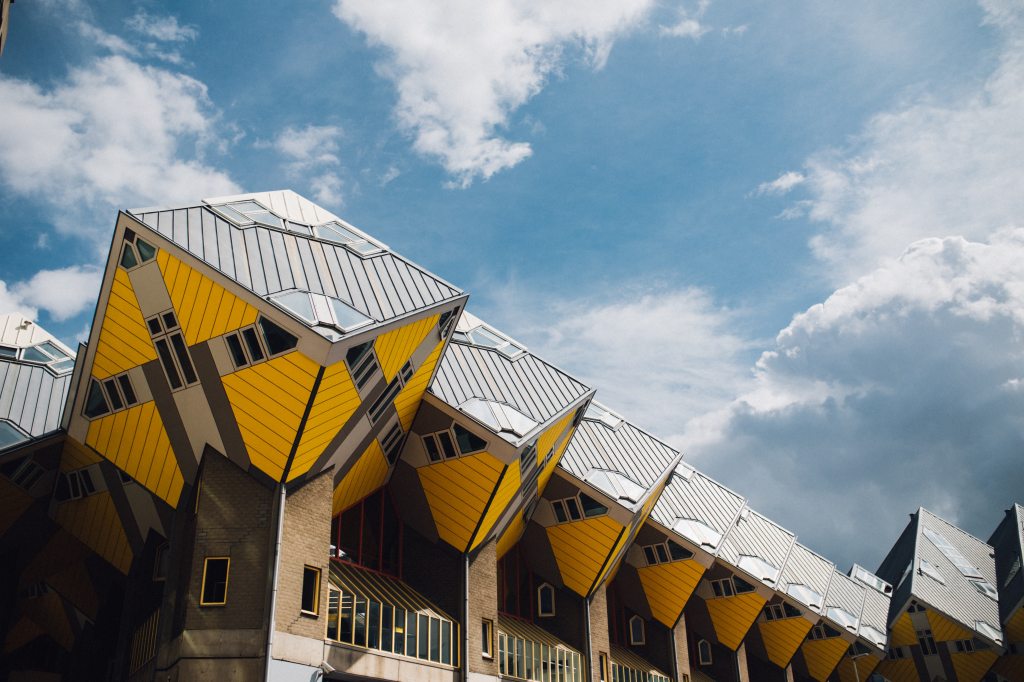
And now for something really exciting: carbon emission from buildings
It is actually very difficult to write something clever on emissions from buildings. The topic itself is, to most people, as interesting as watching the paint dry.
And yet the amount of emissions connected with residential buildings amounts to an eye-watering 17.5% of total emissions.
Mind you, we are only talking about direct energy use. Then there are emission connected with constructions and decommissioning of buildings.
The breakdown is, roughly speaking,10.9% of total emissions for residential buildings and 6.6% for commercial buildings.
Why residential is a worse offender is easy to explain: first there is a lot more houses than shops and offices, as everyone needs a place to live. Second, commercial buildings tend to be newer and hence incorporate, for their very nature, energy efficiency measures.
How much emissions are we talking about? Roughly 2.68 billion tons of CO2 equivalent as per last year. The problem I have with this number is that is difficult to comprehend. To put into perspective, a car emits roughly 4.6 tons per year of CO2. So that’s an awful lot of cars.
To put it into perspective, carbon emissions for these segment are more than 8 times the emissions of the entire aviation industry. They are more than 40% higher than the entire amount of emissions coming from road transport.
Which also means that, by decreasing energy usage for buildings by a half, we would probably accomplish a higher impact than electrifying passenger road transport.
As usual, this is much easier said than done. And it would require a significant investment. The upside is though that, by reducing the carbon footprint of residential and commercial energy use, the economic benefit for families would be tangible and would make essentially possible to have the investment pay for itself.
As for the cost of upgrading the buildings, the common mantra is that this is something that only advanced economies can afford.
Wrong.
According to a paper published by the World Redources Institute, a non-profit organization, there are immense gains to be had even in developing countries.
In this paper https://www.wri.org/news/release-new-research-shows-zero-carbon-buildings-are-possible-where-you-might-least-expect the authors gave a look at the possible gains in efficiency in India, Kenya, Mexico and China. And the results are, to put it mildly, astonishing.
It might be counterintuitive, however in many developing countries heatin and cooking is, for example, still based on burning wood or Kerosene. These are very polluting, high CO2 ways and the simple switch to biomass and natural gas would by itself cut the emission to a fraction of the current level. And if we consider that the growth in emissions (and in population) is likely to come mostly from emerging countries and their rapidly urbanising populations, it makes just sense to focus the efforts on carbon reduction exactly there. Not to mention the fact that if those resources that are currently burned for energy production in poor countries are put to a better use, it would also help substantially the fight against poverty. Talking about win-win. Yet our media seems to be completely oblivious to this topic. Then again also most people are oblivious about my blog. So maybe the media are better at this attention grabbing thing. Which is, really a shame.
However, make no mistake, there are enormous gains to be had as well in developed countries.
For example by looking up on the Swiss website of the IPCC, I have found this bad boy here
Now, only someone with the vocation for accounting, as myself, would go into all the details of this 60 pages reports.
I love details.
Anyway I am going just to give you a few highlights:
- For example, in Germany, a switch from coal and fuel oil/diesel to natural gas and biomass could obtain, by using the baseline of 2002, a reduction on emissions from heating of 26%.
- In Japan, improving insulation in buildings and switching to better home appliances would yield a reduction, compared to a baseline in 2006, of 28% of emissions
But Gennaro, you might say, this stuff is OLD.
Yes it is, data are what they are. However this gives a glimpse of the enormous potential of energy efficiency.
And in my experience especially in developed countries, there is a HUGE stock of buildings that could use improved insulation, double glaze windows and the likes.
Ah, and maybe y’all could put a sweater on. Let me explain. When I was a kid in Italy heating plainly sucked. And as far as I know it still does. And is expensive. So in Winter you would essentially wear a sweater, because you know, it costs money to heat the house. When I moved to the Nordics I was amazed by the heat differentials between inside and outside. And even more so in the US, not to mention the very liberal use of aircon.
Yes, if you want to make an impact, wear a sweater rather than use a plastic straw in your Coke (actually just don’t drink sodas, it’s better).
Anyway I am digressing.
Where do I want to get?
Yes, there is an order of preference when it comes to reduction in residential emissions.
Thanks again to the WRI, we can go back to the old environmentalist adage: Reduction is better.
When it comes to emission reductions there are essentially three avenues:
- Efficiency: the best strategy is always to design the buildings (or retrofit them) with optimal energy use in mind.
- Incorporation of renewable energy on site rather than off-site: to put it in plain English, put solar panels on the roof is better than looking for renewable-off-site energy supply.
- Carbon-offset When everything else fails, or is not possible (think for example residential buildings in historic city: would you put plastic windows and solar panels in the center of Florence?) it should be possible to offset excess emissions from residential power. I like this solution because is market based.
By following this strategy it is actually possible to get to a zero-emissions scenario for buildings.
And that should have people much more excited than we are about, say, electric scooters.
Next up will be Cow farts.Litterally.








 Chainergy
Leave a comment