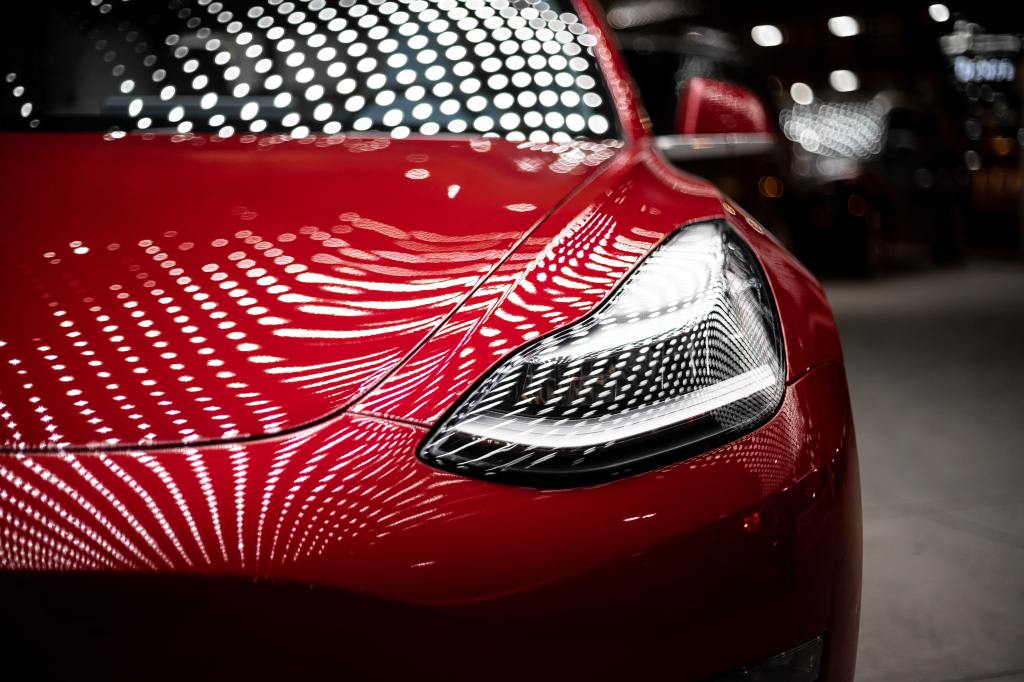
So Tesla has been, finally profitable for a year.
That’s not a fiscal year (last fiscal was still in the red) however in the last 4 quarters it has consistently been profitable.
Good news? Yes. The news is good because, for the first time in this quarter, the sales of its product has lost less than the profit it made from selling credits. It is finally get to the path of sustainable profitability.
In the last 5 quarters a big, yet decreasing part, of Tesla profits have been achieved by selling carbon credits.
This is clearly not sustainable, as other carmakers are increasing their share of electric and hybrid vehicle, the carbon credit market will inevitably shrink, delivering lower Revenues to Tesla.
But here is the REAL good news. I do not honestly care too much if Tesla turns a profit or not.
What I consider good news is that, judging from the trends in the market, is that the carbon credit market is actually doing its job.
It has rewarded Tesla by giving it a cash line that it has kept in business, while it worked to improve its product offering and enhance its profitability.
It has incentivized other car makers to increase their share of EV production. (Renault, VW, PSA and Nissan are all showing increase in volumes and profits coming from EV sales, and are launching even electric commercial vehicles, like vans)
Truth to be told, it is not only the carbon credits that have forced traditional manufacturers to switch to low emission vehicles.
The fuel economy standards introduced by the EU had probably a much higher influence in speeding up this transition.
However this demonstrates that results are best when a mix of market oriented policies (the carbon market) and coercion measures work in tendem.
With coercion only, Tesla, a big innovator, might have not staid in business. The story of their last 5 quarters is clear: the share of profit from carbon credit is decreasing, but without it it would have had serious issues in generating cash.
With Carbon credit only other carmakers might have just avoided speeding up their offering, and just kept on purchasing certificates in the medium terms.
So the mix of measures has achieved a win-win solution for both the industry and consumers.
I do have however a question bouncing around my head around carbon credits.
The way they work, is that a company that produces Zero emission vehicles (Tesla, in this case) “earns” a caron credit, whereas a company that produces a CO2 emitting vehicles gets a “carbon liability”. So essentially the second will have to buy the credit from the first in order to ofsset its negative impact on the environment. Fine. So it is all good, right?
To a point, yes. However a zero emission vehicle is really zero emission only depending on how much of the electricity used to charge it is generated from renewable sources.
If a vehicle is charged by using electricity produced by Coal, for example, that kind of defeat the purpose.
For how the credits are structured, there is not enough emphasis on this side of the matter. Now, it is true that there is a market system also for electricity producers, however this seems to be depressingly ineffective at curbing emissions, witness the disproportionate amount of power that is, to this day, still generated by using Coal, by far the worst offender when it comes to pollution and carbon emission.
I believe the road to tackle climate change is still long, and as long as we keep using coal, it is hard to see how we can make a dent in the emission growth. And no, climate lock down as I heard proposed by some economists are NOT a solution.
Switching power generation to natural gas would actually help a lot more. Wouldn’t be a good idea to incentivize the switch to NG by a bit of coercion as well? I believe so.
For the time being though, let’s enjoy the fact that carmakers are finally producing electric vehicle that we can actually be excited to drive, rather than pathetic style exercises done only for PR purposes.
If there is one thing we can be grateful to Elon Musk, that’s the major one.









 Chainergy
Leave a comment